Large-Scale Wave Soldering remains a practical choice for high-volume through-hole assembly, especially when boards carry connectors, power components, or dense pin rows. In 2026, choosing a machine means looking beyond conveyor speed. Preheat stability, solder-pot design, flux control, nozzle access, and changeover time all affect usable production capacity. A fast line is not automatically a reliable one.
Market context helps explain the investment, but it cannot choose the equipment for you. Fortune Business Insights estimated the global printed circuit board market at USD 76.1 billion in 2023, with a projected value of USD 100.2 billion by 2032. That forecast signals broad electronics growth, not a guaranteed increase in demand for wave soldering. IPC’s J-STD-001 and IPC-A-610 provide widely used requirements and acceptance criteria for soldered assemblies. They make process control and inspection relevant when comparing machine capabilities.
The best large-scale machine should match actual board dimensions, alloy requirements, product mix, and shift patterns. Ask suppliers for evidence from comparable production runs, including solder quality, throughput, and energy use. Then test your own boards. Small details matter: a connector shadow, uneven preheat, or awkward maintenance access can slow a line. Specs alone are not enough. A reflective point: published market forecasts and supplier demonstrations rarely capture every factory constraint. The shortlist should therefore be verified against your operators, process engineers, and real production data.
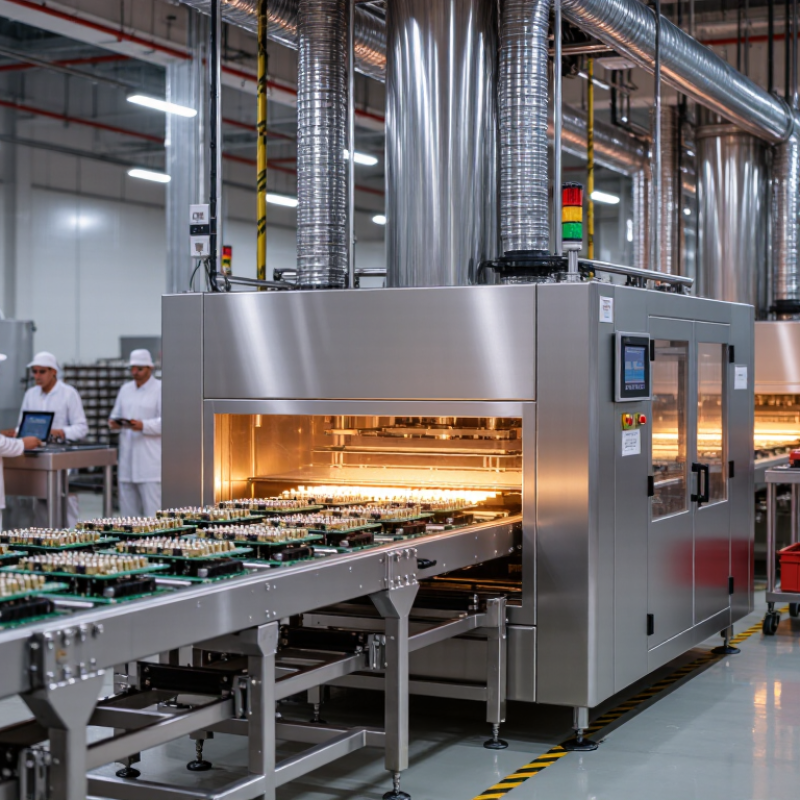
What Is a Large-Scale Wave Soldering Machine?
A large-scale wave soldering machine is built for continuous, high-volume PCB assembly, not defined by one universal size threshold. It typically combines a wide conveyor, multiple preheating zones, a stable solder pot, and adjustable wave height. Boards travel over the molten solder wave while underside joints form; operators monitor conveyor speed, board clearance, and temperature. The label can be misleading: a large machine is not automatically a high-output one. Actual throughput depends on board dimensions, component layout, changeover time, and process settings.
Fortune Business Insights’ PCB market report valued the global PCB market at about $76.26 billion in 2023 and projected $107.57 billion by 2032. That growth signals rising demand for production capacity, but it does not measure wave-soldering machine sales directly. In practice, buyers should check maximum board width, usable heating length, solder-pot capacity, and exhaust handling against real product mix. A long line may still be a poor fit if narrow boards dominate. There is no neat shortcut here.
Tips: Run representative boards before purchase. Record throughput, solder defects, and setup time. IPC J-STD-001 provides soldering requirements; use it alongside your product-specific process criteria.
How Does Wave Soldering Work in High-Volume Production?
In high-volume production, wave soldering turns a controlled sequence into a repeatable flow. Flux is applied to the board underside, then preheating activates the flux and reduces thermal shock. The conveyor carries the board over a pumped molten-solder wave, which wets exposed component leads and plated-through holes. Cooling solidifies the joints. Simple in principle.
The result depends on details: conveyor speed, solder temperature, flux coverage, and preheat profile. A slightly warped board or poorly supported connector can disrupt contact with the wave. Operators therefore check solder pots, nozzles, and thermal profiles, while inspecting joints for bridges, icicles, or incomplete fill. IPC J-STD-001 provides process and soldering requirements used across electronics assembly; it is a useful reference, not a substitute for board-specific trials. The awkward part is that stable settings can still produce defects when board designs change.
Automation supports consistent handling, but robot statistics should not be mistaken for soldering-line performance. The International Federation of Robotics’ World Robotics 2024 report recorded 541,302 industrial robots installed worldwide in 2023, compared with 553,052 in 2022. Those figures show broader factory automation, not wave-solder machine output. For a production line, track actual board throughput, first-pass yield, and downtime. A faster conveyor is not always better. Verify the process on the real assembly.
Which Features Matter Most for Large-Scale Soldering?
2026 Best Large Scale Wave Soldering Machines?
Which Features Matter Most for Large-Scale Soldering?
At high production volumes, prioritize stable process control over headline conveyor speed. Look for adjustable preheat zones, repeatable solder-wave height, and conveyor settings that hold steady across long shifts. A wide solder pot helps accommodate larger boards, but pot capacity alone does not guarantee consistent joints. Check how easily operators can inspect dross, clean nozzles, and access pumps. Small drift matters.
Board support and thermal profiling deserve equal attention. Large or heavy panels can sag, changing contact with the solder wave. Confirm that the machine supports your actual board dimensions and fixtures. Review temperature uniformity across the preheater, and test the profile with representative assemblies. The awkward part: added automation cannot correct poor support or an unsuitable profile. I would not rely on advertised throughput figures alone.
Grand View Research’s Printed Circuit Board Market report valued the global PCB market at about USD 76.2 billion in 2023 and projected 5.7% annual growth through 2030. That points to expanding production needs, but each factory’s product mix differs.
Tips: Run a pilot with your densest boards. Record defect rates, solder temperature, and changeover time. Ask for logged process data, not just a demonstration.
How to Compare Wave Soldering Machines in 2026
Comparing wave soldering machines in 2026 starts with the boards, not the brochure. Record your actual panel width, component density, daily volume, and changeover frequency. Then check whether the conveyor handles those panels steadily without awkward manual adjustments. A wider conveyor is not automatically better if your products are small and frequent changeovers matter.
Look closely at preheat zones, solder-pot capacity, temperature stability, and conveyor speed control. Ask suppliers to run representative boards, including heavy copper areas and heat-sensitive components. Run the real boards. Measure solder fill, bridges, and defects across several panels, not one impressive sample. Flux application and extraction also deserve attention; uneven coverage can create avoidable rework. Request operating data, including energy use and routine maintenance intervals.
Automation features can help at scale, but only when operators can use them reliably. Check how quickly staff can clean the pot, replace filters, and access service points. Review process logging and alarm history, then confirm that the data is easy to retrieve. Numbers can mislead. A machine rated for high throughput may still become a bottleneck during recipe changes or maintenance. I would compare total running cost and usable production time, not just the quoted board-per-hour figure. One detail is easy to miss: test the machine with your normal staffing level.
How to Select a Machine for Your Production Requirements
2026 Best Large Scale Wave Soldering Machines?
How to Select a Machine for Your Production Requirements
Selecting a large-scale wave soldering machine starts with the boards you actually run, not the highest advertised capacity. Record board width, component clearance, daily volume, and product mix. Check that the conveyor handles your widest assemblies without forcing awkward spacing. Fit matters. Leave room for operators to load boards and reach routine service points.
Match heating zones and conveyor speed to the thermal needs of your assemblies. A machine should provide stable preheating and a controllable solder wave across the full board width. Ask for process trials using representative boards, solder, and flux. Review temperature readings at several board locations, not just the machine display. Results can vary with board mass and component layout.
Consider changeovers, maintenance, and utilities alongside purchase price. How long does it take to clean the solder pot or adjust the flux system? Can operators access filters and inspect nozzles safely? Request details on power use, extraction requirements, spare parts, and training. A fast line may still miss your needs if product changes are frequent. I would be cautious about choosing from a specification sheet alone; real production conditions are messier than a sample run. Keep it measurable.
FAQS
Flux coats the board underside. Preheating activates it and reduces thermal shock. The conveyor moves the board over molten solder. The wave wets exposed leads and plated-through holes. Cooling solidifies the joints.
Conveyor speed, solder temperature, flux coverage, and preheat profile all matter. Check them together. A warped board or poorly supported connector can disrupt contact with the wave. Inspect joints for bridges, icicles, and incomplete fill.
Track board throughput, first-pass yield, and downtime. Use actual line data, not general automation statistics. Faster conveyor movement may reduce contact time. Verify changes on real assemblies.
Start with panel width, component density, daily volume, and changeover frequency. Test the actual boards. Fit matters. A wider conveyor may add little value for small products with frequent changes.
Run several panels, including boards with heavy copper areas and heat-sensitive components. Measure solder fill and defects across panels. One sample is not enough. Check flux coverage and extraction too.
Examine preheat zones, solder-pot capacity, temperature stability, and conveyor speed control. Check process logs and alarm history. Operators should be able to retrieve the data easily. That detail gets overlooked.
Time pot cleaning, filter replacement, and nozzle access. Test these tasks with normal staffing. A high-throughput rating can hide maintenance delays or slow recipe changes.
Compare energy use, extraction needs, spare parts, training, and routine maintenance intervals. Assess usable production time too. I would not trust a specification sheet alone; actual production is messier.
Conclusion
Large-Scale Wave Soldering machines are designed to process high volumes of through-hole circuit boards with consistent speed and solder quality. In production, boards move through controlled preheating and a flowing solder wave, which forms joints on exposed leads. Reliable results depend on coordinating conveyor speed, temperature, flux application, and solder-wave conditions with the board design and materials.
When comparing machines in 2026, manufacturers should consider throughput, conveyor width and adjustability, temperature control, energy use, maintenance access, safety features, and compatibility with existing production lines. A suitable system should support the required board sizes and daily output while offering stable process control and practical service requirements. Before selecting equipment, assess current and forecast production volumes, product mix, available floor space, operator needs, and quality targets. Matching these requirements to machine capabilities helps create an efficient soldering process without paying for capacity or features the production line does not need.

 Yichun Electronic