Global electronics production is moving toward faster, traceable, and more automated material handling. IPC’s Electronics Industry Trends reports continue to highlight factory automation, supply-chain resilience, and smart manufacturing as key investment priorities. The IPC World PCB Production Report also shows the strategic importance of efficient printed circuit board production across Asia, Europe, and North America. In this environment, an Automatic Pcb Unloader is more than a conveyor accessory. It removes completed boards from production lines, reduces manual handling, and supports stable downstream flow.
Small details decide performance. A reliable unloader should match panel dimensions, conveyor height, board thickness, and line speed. It should also protect delicate components from vibration and electrostatic discharge. Some models use adjustable magazines, pneumatic clamps, barcode interfaces, and PLC communication. These features can reduce stoppages near reflow ovens and inspection stations. According to market research from Grand View Research, the broader industrial automation market is expanding through demand for connected equipment and labor-saving systems. That trend is visible on the factory floor, where a full magazine can quietly replace repeated manual loading work.
Michael Ford, Senior Director of Emerging Industry Strategy at Aegis Software, has said, “Industry 4.0 is not a technology project; it is a business transformation.” His point applies directly here. Suppliers must prove uptime, service response, software compatibility, and measurable handling quality. No supplier ranking is perfect. Buyer priorities differ. A low-cost machine may appear attractive, yet poor magazine alignment can create expensive micro-stoppages. This guide compares leading Automatic Pcb Unloader suppliers for global buyers, while recognizing that regional support and real production testing still matter.
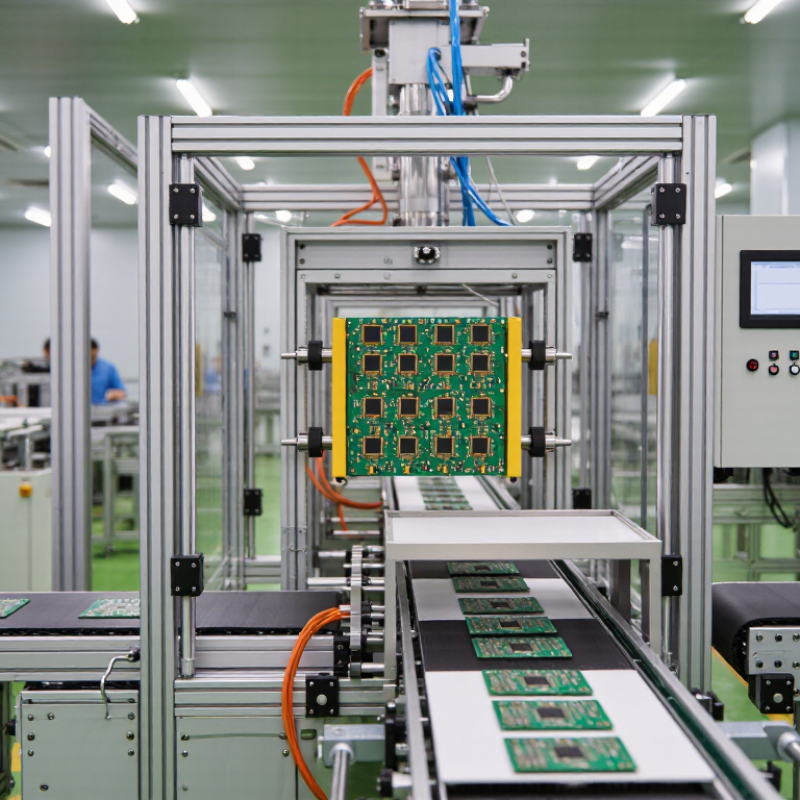
An automatic PCB unloader removes finished circuit boards from a production line. It usually connects a reflow oven, inspection machine, or conveyor. When a board reaches the unloading position, sensors detect its location and size. A servo-driven arm, belt, or lifting platform then transfers it into a magazine rack. The system separates boards with adjustable spacing. This helps prevent scratches, edge damage, and accidental stacking.
The process is simple, but precision matters. The unloader checks board height, conveyor speed, and magazine alignment. Operators can set these values through a touchscreen interface. Many systems also support error alarms and automatic magazine exchange. SEMI reported that global semiconductor manufacturing equipment sales reached approximately 117.5 billion dollars in 2024. That growth reflects stronger demand for factory automation, although PCB assembly has different equipment needs. IPC’s electronics industry research also continues to identify labor availability and production efficiency as major manufacturing concerns. Automation can reduce repetitive handling. It cannot correct poor process settings.
In real production, a flexible unloader is often more useful than the fastest model. A warped board may stop the transfer. Dust can affect sensors. These small issues are easy to underestimate. Buyers should test actual board sizes, magazine formats, and conveyor interfaces before purchasing. A supplier’s response time matters too. One missed alarm can interrupt an entire line.
Top Automatic PCB Unloader Suppliers for Global Buyers
Key Specifications for Comparing PCB Unloader Suppliers
Selecting a PCB unloader requires more than checking the catalogue price. WSTS reported global semiconductor sales of about US$627 billion in 2024, with further growth forecast for 2025. This expansion can increase board volumes and changeover pressure. Compare rated throughput in boards per hour, not only conveyor speed. A practical specification should include PCB sizes, thickness ranges, edge clearance, and maximum stack height. Ask suppliers to demonstrate mixed-board handling, especially when panels are thin, warped, or unevenly supported.
Interface details often reveal engineering quality. Confirm SMEMA or equivalent communication, adjustable conveyor width, ESD protection, and compatibility with upstream inspection or reflow equipment. For traceability, check whether alarms, cycle counts, and recipe changes can connect with factory software. A 2024 IPC industry survey reported continuing pressure on manufacturers to improve productivity and supply-chain visibility. Therefore, remote diagnostics and event logging deserve serious attention. They are not decorative features.
Maintenance data matters too. Request mean time between failures, typical changeover time, spare-part availability, and service response by region. A five-minute width adjustment may save more labor than a slightly faster motor. Ask for acceptance tests using your actual panels. Some suppliers quote impressive cycle rates under ideal conditions; real production is less polite. I would also verify noise, guarding, and operator access before approval. One overlooked detail can become a daily stoppage.
Leading automatic PCB unloader suppliers for global buyers now compete on integration, not only machine price. The WSTS Spring 2024 forecast placed semiconductor sales at 611.2 billion dollars, representing 16% annual growth. That expansion increases pressure on SMT lines to move boards safely and continuously. A capable unloader should match conveyor width, magazine size, board thickness, and line-control protocols. Experienced buyers also check changeover time, sensor accuracy, ESD protection, and fault recovery records.
The IFR World Robotics 2024 report recorded 541,302 new industrial robots installed worldwide in 2023. This figure reflects broader investment in factory automation. However, an automatic PCB unloader is not simply a smaller robot. It must protect delicate edges, maintain stable stacking, and communicate reliably with upstream equipment. Leading suppliers should provide cycle-time tests, interface drawings, and production-site validation. Ask for trials with warped, thin, or panelized boards. Real boards expose weak grippers and unstable magazines.
Traceability matters. Reliable suppliers publish FAT and SAT procedures, spare-parts plans, training coverage, and maintenance intervals. They should explain recovery steps after sensor faults or magazine jams. No supplier is perfect. Some catalogs promise impressive throughput, yet performance may fall with frequent product changes. Global buyers should verify output under actual board sizes and regional power standards. Local service capability also affects total ownership cost, even when the purchase price looks attractive.
For global buyers, an automatic PCB unloader should be judged by measurable performance, not polished brochures. A practical review starts with frame rigidity, conveyor alignment, and board handling accuracy. Ask for cycle-time records under continuous production, not only a short demonstration. A stable unit should move panels without edge damage, scratches, or sudden stops. Inspect sensors, grippers, belts, and emergency controls on a working machine. Small details matter. Request inspection reports, material certificates, calibration records, and traceable serial numbers. Quality claims become more reliable when test conditions are clearly documented.
Compliance requires more than a familiar certificate logo. Confirm electrical safety documentation, risk assessments, factory quality procedures, and destination-market requirements. The supplier should explain which standards apply to the machine configuration and installation site. Do not accept copied documents. Support deserves equal scrutiny. Evaluate response times, spare-parts availability, remote diagnostics, training, and local service coverage. Ask who answers at 2 a.m. when a production line stops. A useful supplier provides wiring diagrams, maintenance schedules, software backups, and clear escalation contacts. Yet no supplier is flawless. I would record unresolved questions and test them during a factory acceptance trial. This step may feel slow, but it exposes weak documentation and unrealistic promises before shipment.
Supplier Evaluation Criteria: Quality, Compliance, and Support
This neutral procurement framework assigns the greatest weight to process quality, regulatory compliance, and after-sales support. Buyers should validate each supplier against documented inspection records, applicable machinery and electrical safety requirements, installation capability, spare-parts availability, throughput, uptime, and factory integration needs.
When selecting an automatic PCB unloader supplier, international buyers should examine more than the machine price. Request drawings showing conveyor height, board thickness range, loading direction, and required cycle time. A supplier should provide test records, electrical specifications, and clear installation procedures. Ask for recent customer references in similar production environments. Real factory conditions often expose problems that brochures hide.
Import planning needs equal attention. Confirm the correct customs classification with a qualified broker before shipment. Duties and documentation can vary by destination. Check whether the equipment matches local voltage, frequency, plug standards, and workplace safety requirements. Clarify the Incoterm, insurance responsibility, wooden-crate treatment, and port charges in writing. Photos of the packed machine help verify export preparation. Small omissions can delay clearance.
The purchase contract should define acceptance testing, spare parts, software access, warranty response time, and remote support hours. Specify who pays for damaged components during transport. A video inspection before dispatch is useful, but it is not a complete factory audit. Ask for a live demonstration using boards similar to yours. A low quote may exclude commissioning, training, or replacement sensors. That can become expensive. Lead times also deserve caution; suppliers may estimate production, but not customs congestion or local installation delays. I would leave schedule space for those risks, even when the sales forecast looks confident.
| Anonymous Supplier Category | Typical Unloader Configuration | Compatible PCB Size Range | Typical Cycle Time | Magazine Capacity | Required Utilities | Automation Interface | Common Compliance Documents | Export and Import Considerations | Indicative Production Lead Time |
|---|---|---|---|---|---|---|---|---|---|
| Standard modular equipment supplier | Automatic PCB unloader with conveyor, lifting platform, magazine loading and board separation | Commonly 50–460 mm wide; length is often adjustable up to approximately 1,200 mm | 8–15 seconds per transfer | Approximately 10–30 magazines, depending on magazine height and board thickness | Compressed air, typically 0.5–0.7 MPa; single-phase or three-phase electrical supply according to the ordered configuration | SMEMA-compatible conveyor signaling; optional factory-network communication may be available | Commercial invoice, packing list, user manual, electrical documents, machine safety declaration and applicable conformity documentation | Confirm voltage, plug type, crate dimensions, gross weight, spare-parts availability and whether installation support is included | 4–8 weeks |
| High-throughput SMT line supplier | Servo-controlled PCB unloader designed for continuous production lines with automatic magazine exchange | Typically 50–460 mm wide; configurable conveyor length and magazine height | 5–10 seconds per transfer | Approximately 20–40 magazines, subject to board thickness and magazine specification | Compressed air, usually 0.5–0.7 MPa; three-phase power is common for larger systems | SMEMA interface, emergency-stop circuit and optional line-control communication | Risk assessment, electrical schematic, maintenance instructions, conformity declaration and factory acceptance test record | Request cycle-time validation using the buyer’s actual PCB, magazine and line layout; verify floor loading and access-door dimensions | 6–12 weeks |
| Compact equipment supplier for limited-floor-space factories | Short-body automatic unloader with reduced conveyor length and manual or semi-automatic magazine handling | Commonly 50–330 mm wide; maximum board length depends on the compact frame design | 10–20 seconds per transfer | Approximately 5–15 magazines | Compressed air, typically 0.5–0.6 MPa; standard industrial electrical supply | SMEMA-compatible signaling is commonly specified | Commercial invoice, packing list, operating manual, spare-parts list and safety documentation | Measure the complete installation area, including maintenance clearance, magazine loading space and operator access | 3–6 weeks |
| Heavy-duty supplier for large or rigid PCB applications | Reinforced automatic unloader with wider conveyor, stronger lifting mechanism and adjustable board support | Often configured for boards up to approximately 460–610 mm wide, subject to engineering review | 10–25 seconds per transfer | Approximately 10–30 magazines | Compressed air, commonly 0.5–0.7 MPa; electrical requirements depend on lifting load and conveyor length | SMEMA interface with additional safety interlocks and optional production-line signals | Load specification, safety assessment, electrical drawings, factory test record and preventive-maintenance instructions | Confirm maximum PCB mass, board warpage limits, lifting capacity, crate handling method and unloading equipment at destination | 8–14 weeks |
| Custom-engineering supplier | Application-specific unloader with customized conveyor height, magazine dimensions, board orientation or special handling | Defined by the approved technical drawing; non-standard sizes require engineering confirmation | Project-specific; validate with a production sample or simulation | Project-specific; based on magazine dimensions, board thickness and required autonomy | Specified during design review; air pressure, flow rate, voltage and power rating must be stated in the final quotation | SMEMA or customer-defined interface; integration testing should be included in the acceptance plan | Approved drawings, bill of materials, risk assessment, electrical documents, test protocol and final operating manual | Use a signed technical specification covering tolerances, acceptance criteria, installation responsibility, warranty scope and change-control procedures | 10–20 weeks |
| Regional service-oriented supplier | Standard automatic unloader with local commissioning, operator training and stocked maintenance parts | Usually 50–460 mm wide for standard production-line formats | 8–15 seconds per transfer | Approximately 10–30 magazines | Compressed air, typically 0.5–0.7 MPa; local electrical configuration should be confirmed before ordering | SMEMA-compatible interface; local integration support may reduce commissioning time | Local conformity documents where applicable, invoice, packing list, manual, warranty terms and service contact information | Compare total landed cost, local tax treatment, after-sales response time, technician travel charges and replacement-part delivery time | 4–10 weeks |
| Market-reference figures are typical planning ranges for automatic PCB unloaders rather than guarantees for any individual supplier. Buyers should confirm final specifications, certification, Incoterms, customs classification, voltage, cycle time and acceptance criteria in the purchase contract. | |||||||||
Check frame rigidity, conveyor alignment, and board-handling accuracy. Request cycle-time records from continuous production. A short demonstration is not enough. Inspect belts, sensors, grippers, and emergency controls. The machine should avoid scratches, edge damage, and sudden stops.
Ask for documented tests using boards similar to yours. Records should show cycle time, board thickness, loading direction, and conveyor height. Test conditions must be clear. Otherwise, performance claims remain difficult to judge.
Request inspection reports, material certificates, calibration records, and traceable serial numbers. Also request electrical specifications and maintenance instructions. Copied documents create doubt. I would record every unanswered question.
Confirm electrical safety documents, risk assessments, and factory quality procedures. Check requirements for the destination market and installation site. The supplier should explain which standards fit the exact machine configuration. A certificate logo alone proves very little.
Evaluate response times, spare-parts availability, remote diagnostics, training, and local service coverage. Ask who responds when production stops at 2 a.m. Useful support includes wiring diagrams, software backups, maintenance schedules, and escalation contacts. Promises can sound better than reality.
Confirm customs classification with a qualified broker before shipment. Check voltage, frequency, plug standards, and workplace safety requirements. Clarify the Incoterm, insurance responsibility, crate treatment, and port charges. Photos of the packed machine can reveal missing export preparation.
Define acceptance testing, spare parts, software access, warranty response time, and remote support hours. State who pays for transport damage. Include commissioning and training responsibilities. A low quote may exclude replacement sensors or installation.
Request a live demonstration with comparable boards. Use a video inspection before dispatch, but do not treat it as a full factory audit. Allow extra time for customs congestion and local installation. Sales forecasts may look confident. They can still be wrong.
An Automatic Pcb Unloader is an automated system used to remove finished printed circuit boards from production equipment and transfer them safely to the next processing stage or a storage area. By coordinating conveyors, sensors, lifting mechanisms, and control software, it can improve production flow, reduce manual handling, and support consistent board quality. When comparing suppliers, global buyers should review unloading speed, compatible board sizes, loading capacity, placement accuracy, equipment footprint, control interfaces, and compatibility with existing assembly lines.
A reliable supplier should demonstrate stable manufacturing quality, clear technical documentation, appropriate safety features, and compliance with relevant international requirements. Buyers should also assess customization capabilities, installation guidance, spare-parts availability, warranty coverage, and after-sales support. For international purchasing, important considerations include electrical standards, packaging protection, shipping terms, import documentation, customs requirements, delivery schedules, and local service arrangements. A careful evaluation of both machine performance and supplier support can help buyers select a dependable solution for long-term production needs.

Yichun Electronic